Transdisciplinary Practice
in Context


This project holds much more importance than it would seem on the surface, and I am very well aware of that. The fact is that being able to add my own brick into the structure that previous researcher have created and pass it on to others holds a lot of importance for me personally.
Where does the project currently sit?
Body as Pattern began as a multidisciplinary project, bringing together dance, music production, digital fashion design and video documentation as separate but parallel practices. Each discipline contributed its own tools and methods without yet transforming the others. As the research developed however, the project moved into interdisciplinary territory. The music began to shape the movement. The movement began to generate the design. The disciplines started to influence one another rather than simply coexist.
The project is now in active transition towards transdisciplinarity, and this page argues both where that transition is happening and what would make it complete.
What makes it transdisciplinary?
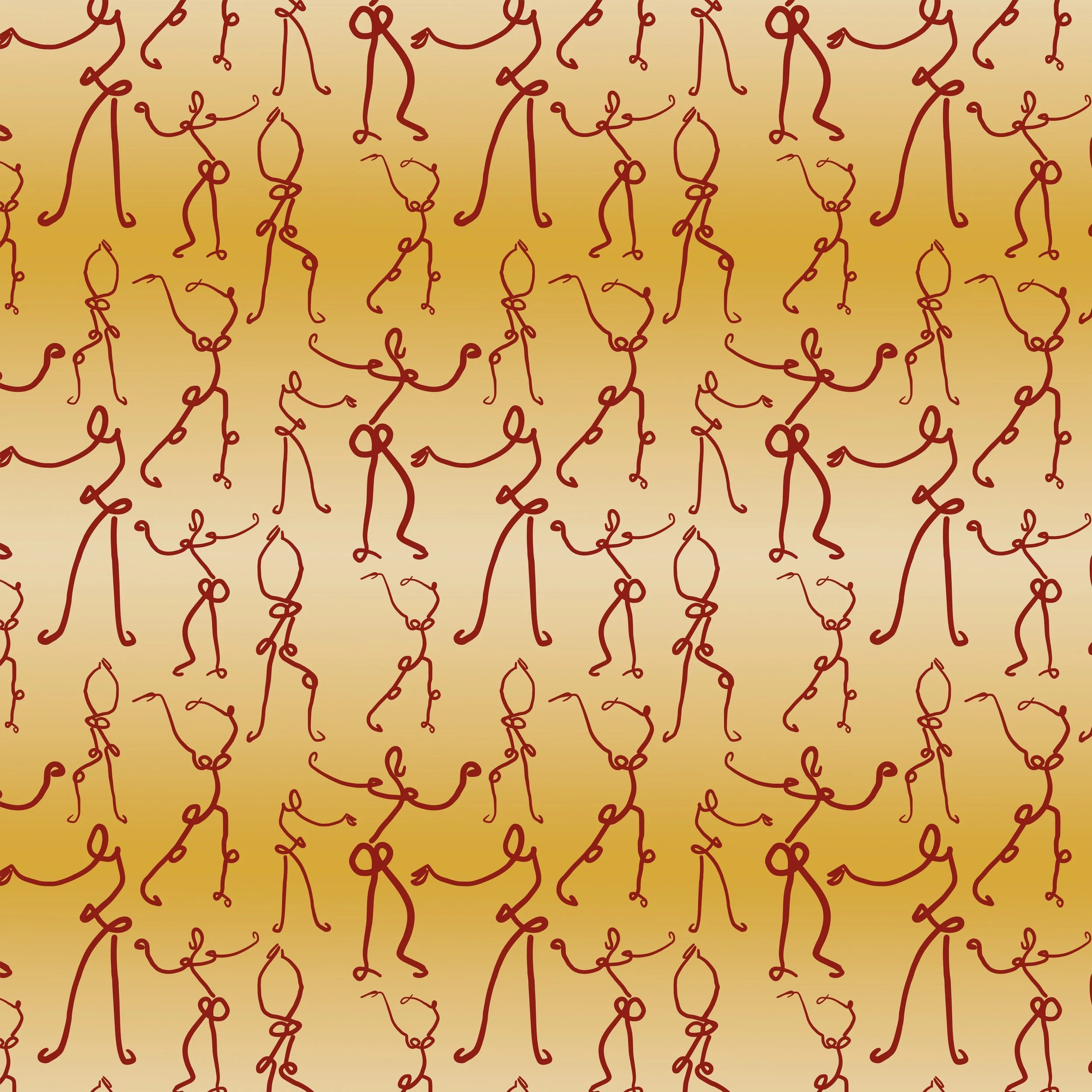
Body as Pattern is reaching transdisciplinary territory in several concrete ways. The surface patterns produced in this project do not belong to fashion design, to dance or to music. They are born from the encounter between all three. A fashion designer working alone would never produce these patterns. A dancer working alone would never generate them either. They exist only because of the exchange between movement, sound and design thinking.
The most significant transdisciplinary moment in the project so far occurred when Wendy was shown her own freeze captures and asked to describe what she saw. Her responses, sharp and edgy for the Deep House section, earthy, wide and round for the Ndombolo section, directly informed the design direction of the surface patterns. This is the moment where the knowledge stopped flowing in one direction. Wendy was no longer just the source of the research. She became a co-author of its visual language.
The silhouette and structural decisions of the garment were not made by the designer alone. Wendy's reading of her own freeze captures directly informed the cut, volume and panelling of each piece. The garment is as much hers as it is mine. This is what makes the exchange genuinely transdisciplinary : the knowledge did not just flow from the dancer to the designer. It shaped the final object.
The musical choices that structure the research are not arbitrary. Steingo (2016) demonstrates that house music in an African context is not simply a borrowed Western genre but a culturally situated practice that carries its own aesthetics and social meanings. The Deep House section of the mix therefore brings with it a specific cultural energy that shapes how an African dancer like Wendy inhabits and responds to the sound. Similarly, Gondola (1997) shows that Congolese popular music is deeply embedded in urban social life and bodily practice. The Ndombolo is not just a rhythm. It is a corporeal language. When Wendy describes feeling the earth beneath her feet in the Ndombolo section, she is drawing on a physical knowledge that is culturally encoded in the music itself.
Where is it not yet fully transdisciplinary?
Body as Pattern has not yet fully achieved transdisciplinarity. The methodology is established and the design language is emerging, but the final synthesis, the 3D garment animated on the original music, has not yet been realised. Until the garment exists and moves, the full transdisciplinary loop remains open.
Agawu (2003) argues that African music cannot be separated from movement, that rhythm and bodily response are inseparable in African musical traditions. This insight is central to the methodology of Body as Pattern : the music does not accompany the dance, it generates it. The garment that emerges from this process will therefore carry not just the dancer's individual movement vocabulary but the cultural intelligence embedded in the music itself. That is what will make the final outcome genuinely transdisciplinary.
How will it become fully transdisciplinary?
The loop closes when the garment is animated on the music and shown back to Wendy. At that moment, the object born from her movement returns to her as a new proposition, a new way of seeing what her body was doing. If that object changes how she thinks about her own movement, the knowledge will have completed its cycle. No single discipline could have produced that cycle alone.
The method itself, body as pattern, is also potentially transferable beyond this project. Applied to other dancers, other musical traditions and other cultural contexts, it could generate entirely new design languages. This transferability is what would make it not just transdisciplinary in practice, but transdisciplinary as a methodology.
Bibliography
Agawu, K. (2003) Representing African Music: Postcolonial Notes, Queries, Positions. New York: Routledge.
Gondola, C.D. (1997) 'Popular Music, Urban Society and Changing Gender Relations in Kinshasa, Zaire (1950-1990)' in Grosz-Ngaté, M. and Kokole, O.H. (eds.) Gendered Encounters: Challenging Cultural Boundaries and Social Hierarchies in Africa. New York: Routledge, pp.65-84.
Steingo, G. (2016) Kwaito's Promise: Music and the Aesthetics of Freedom in South Africa. Chicago: University of Chicago Press.