Research
Process
Session 1
Mimi | Warm Up Exploration Friday 6 March
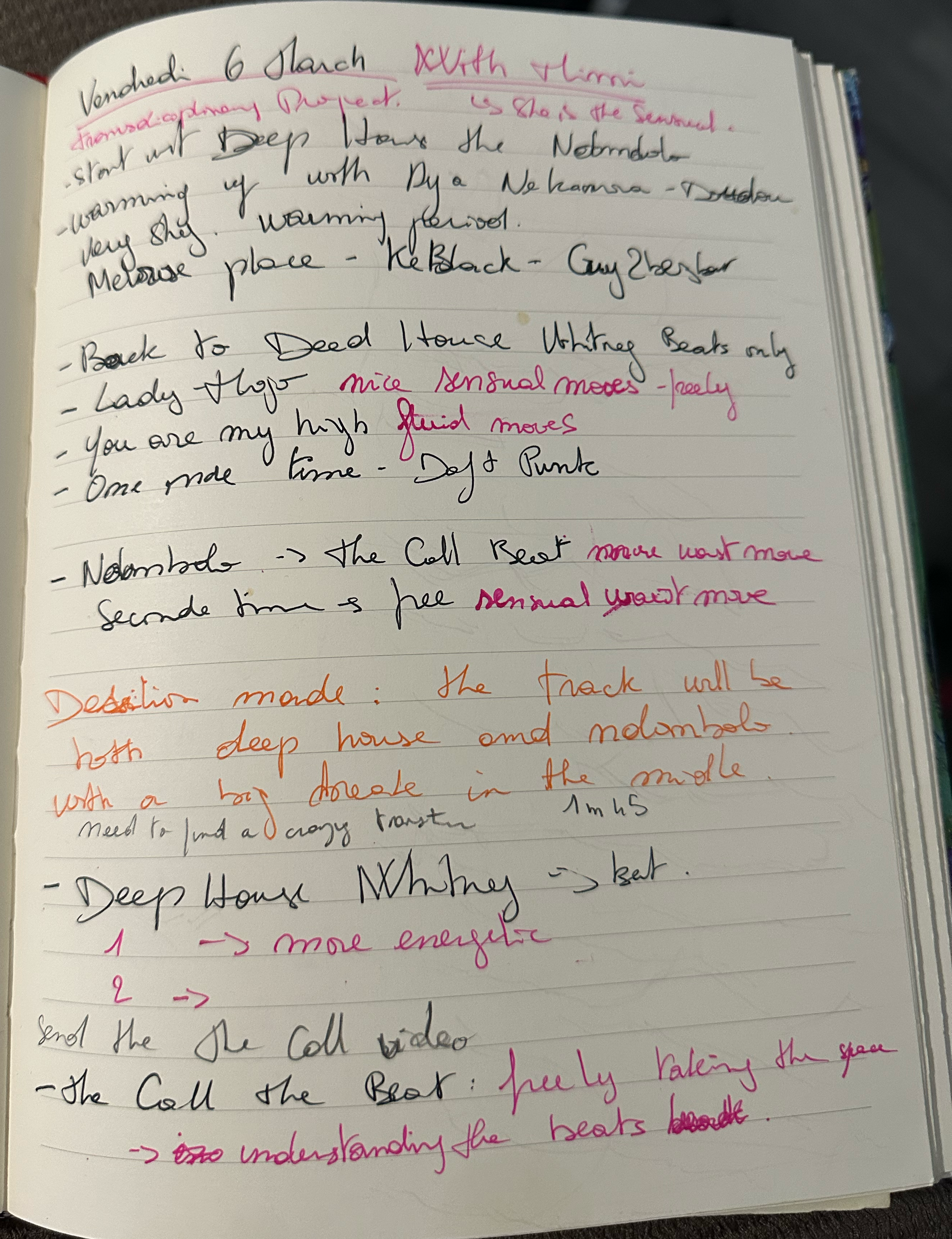
Warming up Session’s note:
Vendredi 6 March – with Mimi
Transdisciplinary project
→ she is the sensual
• Start with Deep House then Ndombolo
• Warming up with Aya Nakamura – Doudou
Very shy – warming sensual
Melrose Place – Kelblack – Guy Gerber
• Back to Deep House – Whitney Beats only
• Lady – nice sensual moves – freely
• You Are My High – fluid moves
• One More Time – Daft Punk
• Ndombolo → The Call Beat
more waist movement
Second time = free sensual waist move
Decision made :
The track will be both deep house and ndombolo
with a big break in the middle
Need to find a crazy transition
1m45
• Deep House Whitney → beat
1 → more energetic
2 →
Send the The Call video
• The Call – the beat
freely taking the space
→ also understanding the beat break
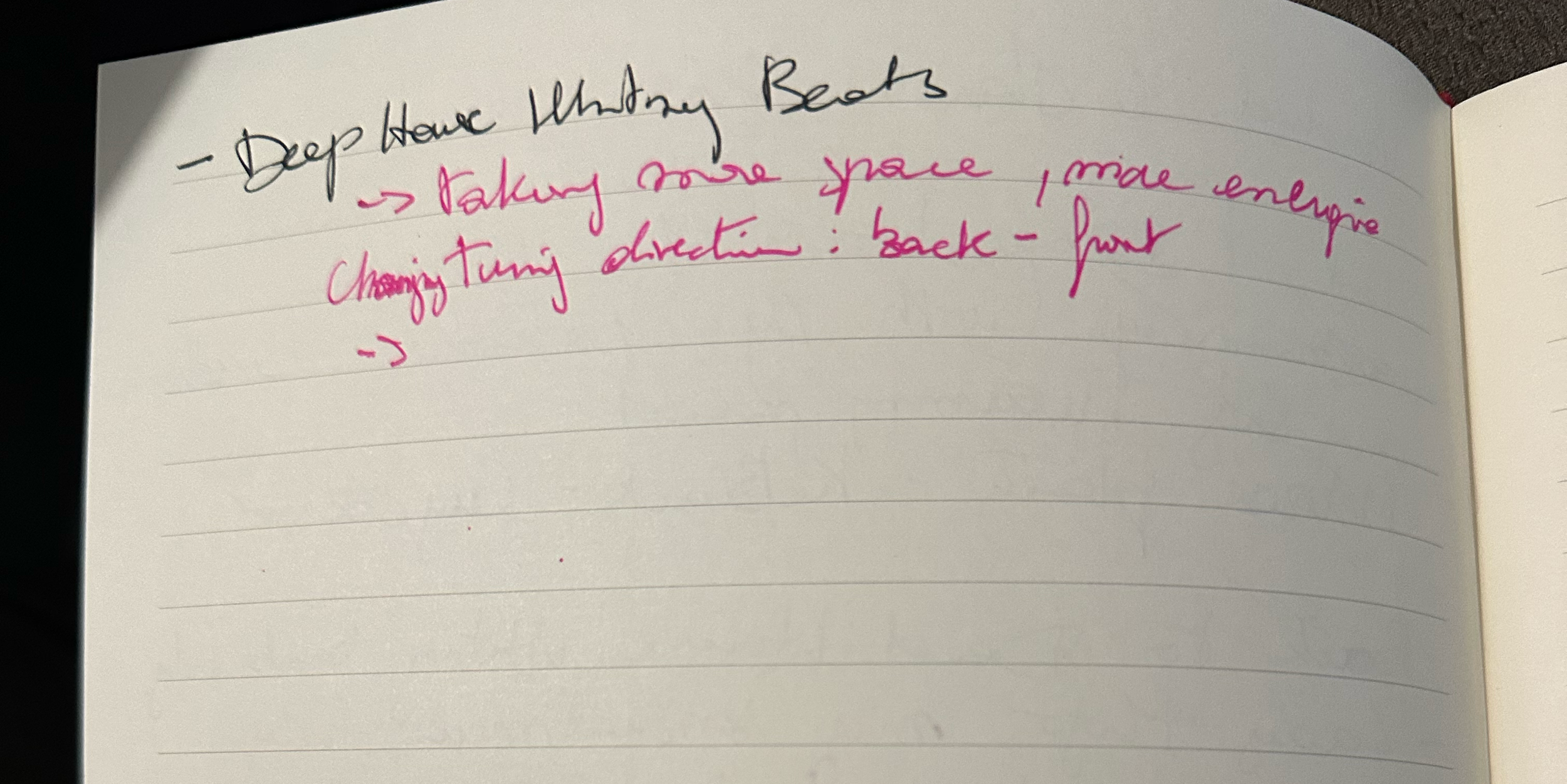
Next page
• Deep House Whitney Beats
→ taking more space
→ more energy
Changing / turning direction
back – front
The research process is built around collaborative dance sessions guided by an original music composition. Each session is filmed, analysed and used to generate design material. The process is iterative and evolves with each new collaborator and each new session.
Context
The first session functioned as an introduction to the research process. The goal was to become familiar with the method and begin exploring how the body reacts to different musical environments. The session took place in an open studio environment and focused on improvisational movement
Music Environment
The exploration began with Deep House music to encourage fluid and sensual movement qualities. Later in the session, the possibility of introducing Ndombolo rhythms was discussed. Deep House encourages continuous and flowing movement, while Ndombolo generates more grounded and rhythmic body dynamics.
Movement Observations
During the first exploration, the movement remained relatively contained within a small area of space. Several observations emerged during the session :
Movement stayed mostly within a limited spatial zone
Gestures were relatively small and controlled
Movement direction remained mostly frontal
To expand the physical vocabulary, several suggestions were introduced :
Using the full space of the room
Exploring forward and backward trajectories
Increasing the amplitude of gestures
Allowing the body to respond more freely to the rhythm
Research Notes
The first session revealed how strongly music influences the quality of movement. Deep House rhythms produced fluid and sensual gestures, while the introduction of Ndombolo was expected to generate more energetic and grounded movements. This session therefore functioned as a preparation phase, and its observations directly guided the main capture session with Wendy.
Session 2
Wendy | Main Movement Capture April 2026
Context
The second session marked the transition from exploration to main capture. Wendy, an experienced afro dance practitioner based in the North West of England, brought a deep physical vocabulary rooted in West African and Ndombolo dance traditions. The session was conducted using the final music mix produced specifically for the project, combining House of Whitney and The Call into a single two minute sequence. Two full takes were recorded and documented.
Music Environment
The mix structured the session into two distinct movement environments. The Deep House section of House of Whitney opened the session with a fluid and continuous groove, designed to encourage spatial and exploratory movement. The Ndombolo section of The Call followed, generating a shift towards grounded, rhythmic and culturally rooted body dynamics. The transitional break between the two parts created a moment of physical reset that proved significant in both takes.
Movement Observations - First Take
Deep House
Wendy was immediately free and energetic. Her improvisation was instinctive and uninhibited, with a high level of energy and a concentrated, happy mood. She used approximately 60% of the available space, moving primarily from side to side with limited movement forward and backward.
Ndombolo
Wendy felt the beats deeply and responded with large, powerful African moves combined with moments of slow motion. She looked and felt fully inspired, completely in her element.
Movement Observations - Second Take
Deep House
The second take was noticeably more fluid and confident. Wendy brought strong attitude, incorporating vogue moves and a rounded, assured energy. She was visibly happier and smiling throughout. Her use of space expanded to approximately 80%, moving both side to side and front to back. She was telling a story with her body, exploring the world of Deep House with curiosity and pleasure, trying movements outside her usual vocabulary.
Ndombolo
In the Ndombolo section Wendy was completely at home. She felt the earth beneath her feet and the beats instinctively. She combined West African moves with Ndombolo vocabulary, bringing more energy and playfulness than the first take. Her use of space reached approximately 75% in all directions.
Overall Observation
The contrast between the two sessions and the two musical styles revealed something essential to the research. In Deep House, Wendy was discovering, exploring, telling a story. In Ndombolo, she was at home, mastering, feeling the ground beneath her. These two states of the body, discovery and mastery, generate two fundamentally different visual languages for the design process. Wendy is an exceptionally professional, energetic and talented dancer, and her physical intelligence across both styles proved invaluable to the research.
Dancer Feedback on Design Direction
Following the session, Wendy was shown freeze captures from the footage and asked to describe what she saw and felt in her own frozen body. Her responses directly informed the design direction :
Deep House : sharp edges, edgy forms
Ndombolo : earthy, wide, round shapes rooted in the ground
These responses represent a key moment of transdisciplinary exchange in the project. The knowledge did not flow in one direction only. The dancer's reading of her own body became a co-authoring act in the design process.
Interview with Wendy following the movement capture session.
She discusses her dance background and her experience of the two musical environments.
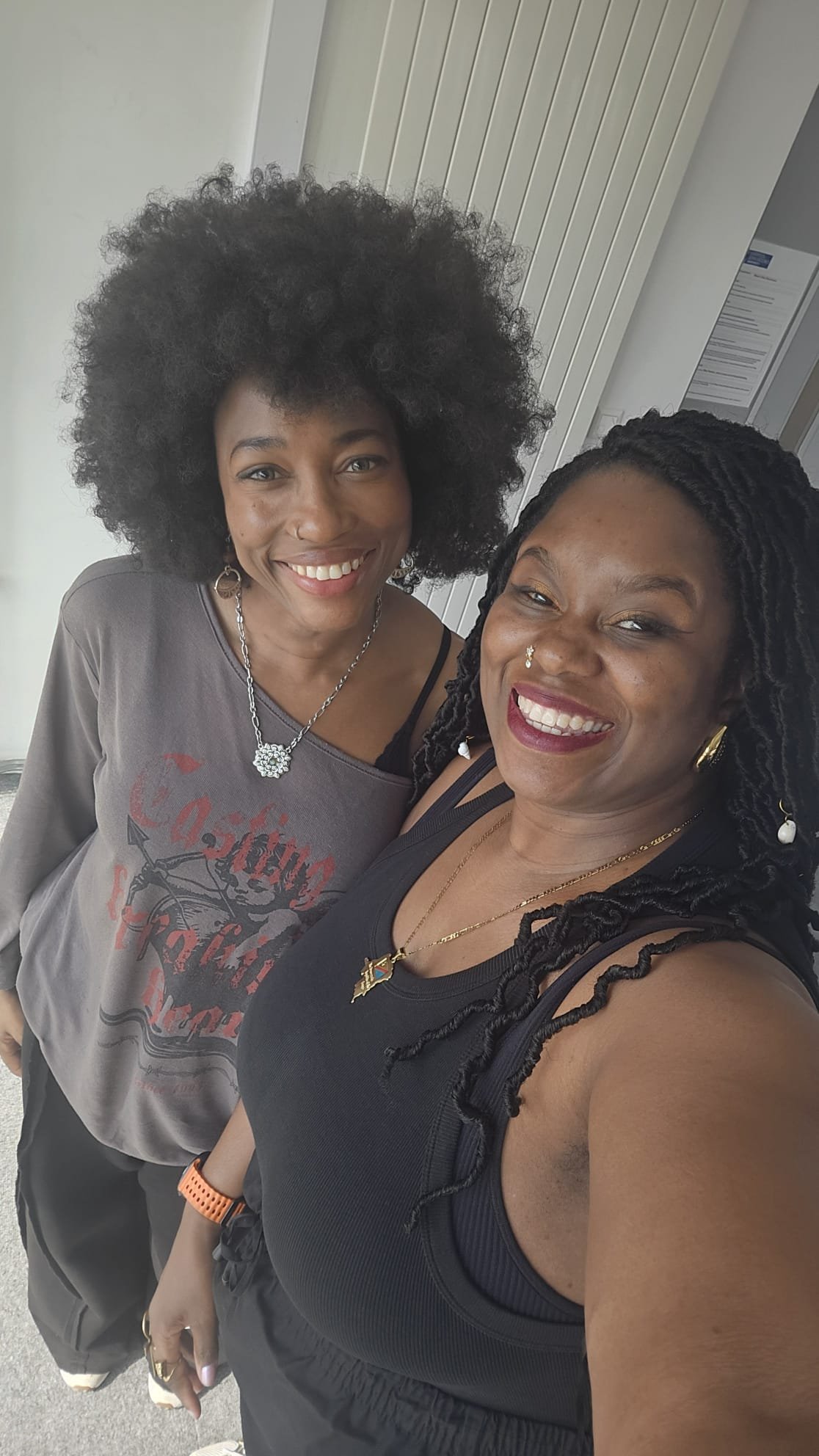
Wendy and Sandrine after the movement capture session, April 2026.